Cross-team problems
Product, engineering and operations each hold part of the answer. I translate without flattening the detail.
Product & technology leader · operations, AI systems and new products
I take ambiguous work from the first useful version to an operating capability. The pattern spans offshore operations, delivery teams, AI systems and new ventures.
I can’t leave broken processes alone.
I started with a commercial uncrewed survey vessel. With the team, I took it from initial build through testing, marketing, sale and operation on client work.
The scope widened from one sold and operating vessel to a regional service, then to delivery systems and products. I now follow a simple loop. I find what is failing, build a working version and test it with the people who will use it. Then I improve it until it works reliably in daily use.
Build, testing, marketing, sale and operation on client work.
Room, network, video, workflows, team and first live operations.
Edge telemetry, agent infrastructure and ventures built from the same instinct.
Product, engineering and operations each hold part of the answer. I translate without flattening the detail.
I learn by making something concrete enough to test, then use the result to decide what comes next.
I care about authority, failure paths, handovers, users and the operating environment around the code.
Poor fit: maintaining a roadmap nobody believes, polishing a settled system by another two percent, or a role where ownership stops at the job description.
Delivered outcomes, active systems and modelled opportunities stay clearly labelled.
I owned the full delivery cycle with the team: initial build, testing, marketing, sale and operation on client projects. The next mandate was to turn that learning into a regional service.
Career record, 2020: implementation, commissioning, the remote operations centre, remote rig move and regional video-streaming solution were marked complete.
With the team, I took Lady Nerissa through build, commissioning, field testing, marketing, sale and client deployment. I then led the regional centre across hardware, networks, procurement, video, global alignment, operating workflows and team building.
Early USV product work became a remote service. Fugro Pegasus shows where the regional programme went next.
Positioning problems are hard to diagnose from scattered receiver screens, messages and snapshots. By the time the right person sees the pattern, the useful evidence may be gone.
I conceived and built Holocron, a passive edge-to-cloud telemetry system. It captures receiver health, buffers data through intermittent links, and gives operations a live fleet view with incident history.
GNSS receivers feed a native edge service that buffers events locally and sends them over HTTPS. A central service parses and stores them in PostgreSQL/PostGIS, while a MapLibre interface supports fleet triage and incident replay. The public visual is deliberately sanitised.
Coding agents can produce locally correct changes while losing the architecture they were meant to build. The plan goes stale. The next session starts again.
Cairn gives the agent a living architecture map to update as it works. It reconciles the map against the repository, reports drift and can block a conflicting commit.
A map the agent writes, a gate the model cannot talk around.
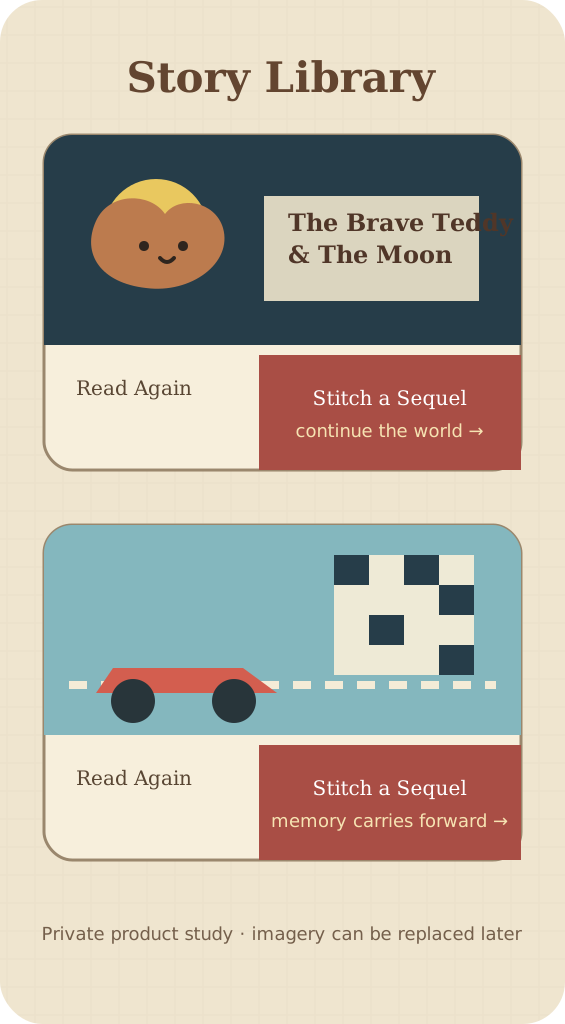
Generated stories often forget the child, the character and everything that happened before. Each new story starts from zero.
Yarnling turns a photograph of a toy into a persistent character. The story world remembers the child, earlier events and the small details that make a sequel feel like a return.
Tools I built to solve problems I kept running into across AI, design and physical systems.
A private, local-first memory system that lets several AI tools share one portable record of decisions, fixes and handoffs.
Exact, semantic and relationship-aware retrieval share one inspectable SQLite file, with public benchmarks and explicit trade-offs.
A self-hosted control layer for personal AI. Its reference assistant, Lyra, takes one clear job at a time. Each task is bounded, tested and recorded. The full loop for growing responsibility is still being built.
Lyra can learn a repeated job. It cannot promote itself. New routines stay inactive until you approve them. You can limit, pause or remove them later.
A multi-agent design workflow that separates visual direction, implementation and blind review before changes reach the existing frontend.
Design judgement becomes a recorded, bounded workflow with durable product context, visual rules and evidence from the rendered result.
Linked workshops that test an offer, lead generation and customer copy. Independent agents attack the market, maths, message and execution plan.
Business assumptions become explicit, reviewable and reusable instead of remaining inside one conversation.
A command-line tool that lets people and AI inspect, render and evaluate interactive Rive animation files in repeatable steps.
The same file can be inspected, rendered and scored in repeatable steps, so an agent can check its own output.
A command line that lets an agent inspect, calibrate and drive a real laser engraver through explicit safety gates.
The software has produced a real engraving, moving the proof beyond a simulator or interface demo.
A talking face for the web, driven by text, speech and expression, with support for custom avatars.
An agent gains visible presence while the mechanism remains open enough to inspect and change.
Exploring how reusable agent skills can stay portable across different clients.
Source ↗These products test the same ownership pattern against customers, families, regulation and production.
An agent services business building assistants for communication and operating workflows where mistakes have real costs.
The work tests agent architecture against customer workflows, communication channels and the cost of getting an action wrong.
OG MallowA product venture carried through production and sales.A family product venture spanning recipe, packaging, sourcing, licensing, production and direct selling.
The idea has been tested against materials, regulation, production constraints and real customers.
Three moves recur across the work above.
Map the incentives, dependencies, handovers, authority and failure paths before accepting the requested solution.
Make the idea concrete enough for a user, operator, machine or codebase to prove it wrong.
Watch what happens, fix the weak link and document the decisions that must survive the first version.
At twelve, I built my first computer. At university, I made an Android app that controlled a Leica laser measure and captured its readings. Years later, I was connecting vessels to remote operations centres.
Now the work spans AI control layers, memory systems, children’s products and tools that drive real machines. I learn by making, then turn what survives into something other people can inspect and reuse.
Tell me what is failing, what matters and what has already been tried.
george@reid-dowd.meStrongest fit